
10 Lead Generation Strategies for Small Business Owners That Work in 2026
The best lead generation strategies for small business owners share one thing in common: they work without a big team or a big budget. As a small business owner, you do not need enterprise software or a marketing department. You need a handful of proven strategies executed consistently.
This guide covers ten lead generation strategies specifically chosen for small business owners – practical, affordable, and field-tested.

What Makes Lead Generation Different for Small Businesses
Large companies can afford to throw money at the problem. Small business owners cannot – and honestly, should not. Your advantages are different:
- You can be personal. People buy from people. A small business owner who shows up authentically beats a faceless brand.
- You can move fast. No approval committees. You can test an idea today.
- You can niche down. Serving a specific audience deeply beats serving everyone shallowly.
Every strategy below leverages those advantages.
1. Build Your Lead Generation Foundation First
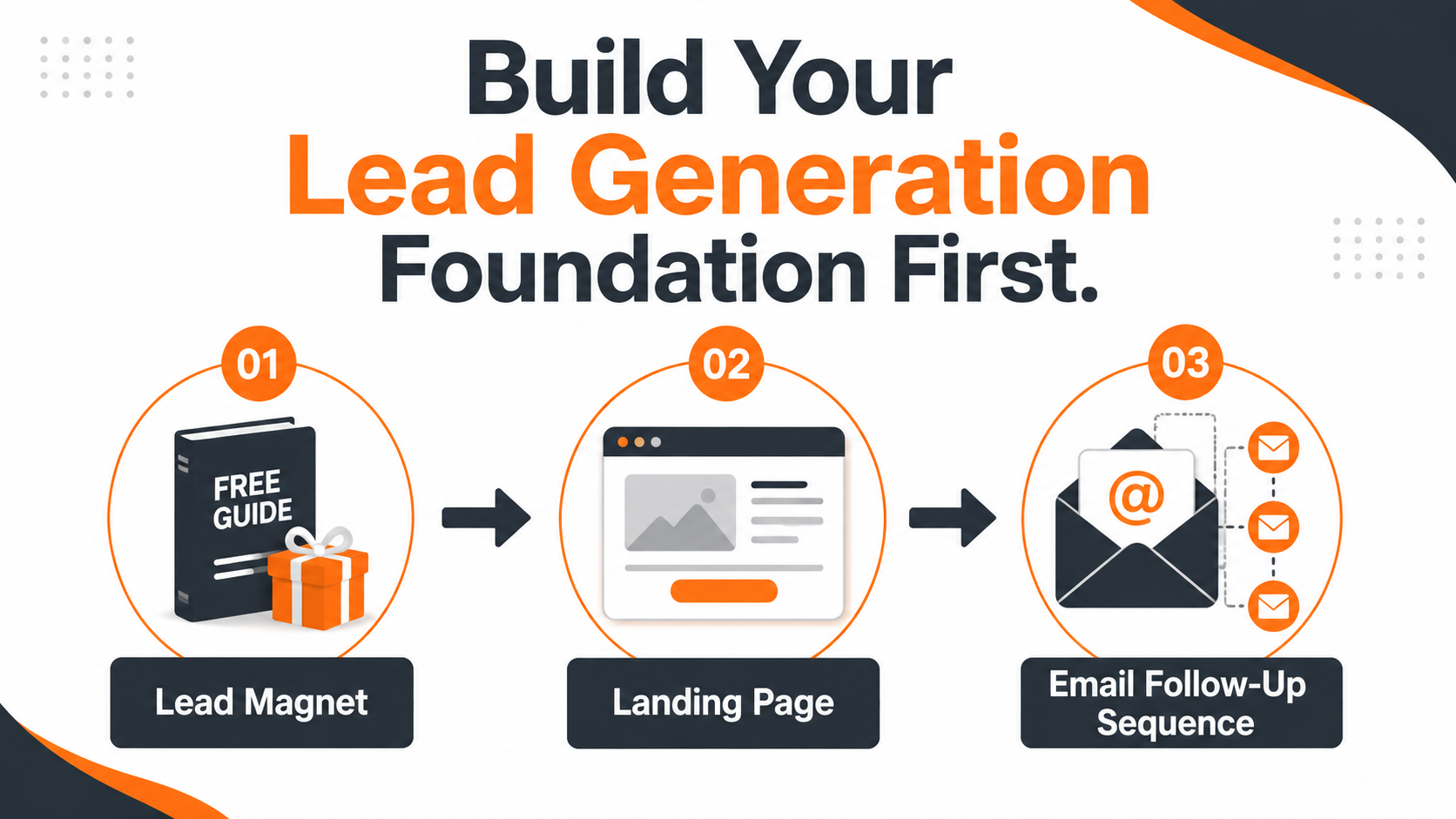
Before any traffic strategy works, you need three pieces in place:
- A lead magnet – a free resource that solves one specific problem for your ideal customer
- A landing page – a simple page where visitors exchange their email for your lead magnet
- An email follow-up sequence – automated emails that build trust after someone subscribes
Skip this foundation and every other strategy leaks. If you need a step-by-step walkthrough, my free Lead Generation Blueprint covers the complete setup.
2. Local SEO and Google Business Profile
If your business serves a local area, your Google Business Profile is the highest-leverage free asset you have. Complete every field, add photos, collect reviews consistently, and post updates weekly. When someone nearby searches for what you do, you want to be the obvious choice in the map results.
3. Strategic Content Marketing
Write articles that answer the exact questions your customers type into Google. Not company news. Not fluff. Real answers to real questions. Each article should end with a clear next step – usually your lead magnet. One good article per week compounds into a serious traffic asset within a year.
4. Email Marketing – Your Highest ROI Channel
Email consistently delivers the highest return on investment of any marketing channel. Your email list is also the only audience you truly own – no algorithm can take it away. Send a helpful email at least weekly. Teach something. Share a quick win. Then make a soft offer.

5. Referral Systems That Run Themselves
Most small businesses get referrals by accident. Build a system instead: ask every happy customer at the moment of peak satisfaction, make sharing effortless with pre-written messages, and consider a small thank-you incentive. Referred leads close faster and stay longer than any other lead source.
6. Strategic Partnerships
Identify businesses that serve your exact audience without competing with you. An accountant and a bookkeeper. A wedding photographer and a florist. Cross-promote each other’s lead magnets to your respective email lists. One good partnership can double your lead flow overnight.
7. Social Media With a System
Pick one or two platforms where your customers actually spend time – and ignore the rest. Post consistently using a simple rotation: a helpful tip, a behind-the-scenes look, a customer win, and an invitation to your lead magnet. Consistency beats brilliance.
8. Speak Where Your Customers Gather
Local business groups, chamber of commerce events, industry webinars, podcasts in your niche – every speaking opportunity positions you as the expert and puts you in front of pre-qualified leads. Always close with your lead magnet, not a sales pitch.
9. Leverage Customer Reviews and Testimonials
Social proof is lead generation fuel. Collect reviews systematically on Google, Facebook, and industry platforms. Feature testimonials on your landing pages. A specific testimonial – “increased our leads by 40% in 60 days” – outperforms a generic one every time.
10. Automate Your Follow-Up
Most leads do not buy on first contact – they buy after five to twelve touches. Automation does the touching for you. A simple automated email sequence nurtures every lead consistently, even while you sleep. This is where small businesses quietly outperform bigger competitors who let leads go cold.
Putting It All Together: Your 30-Day Plan
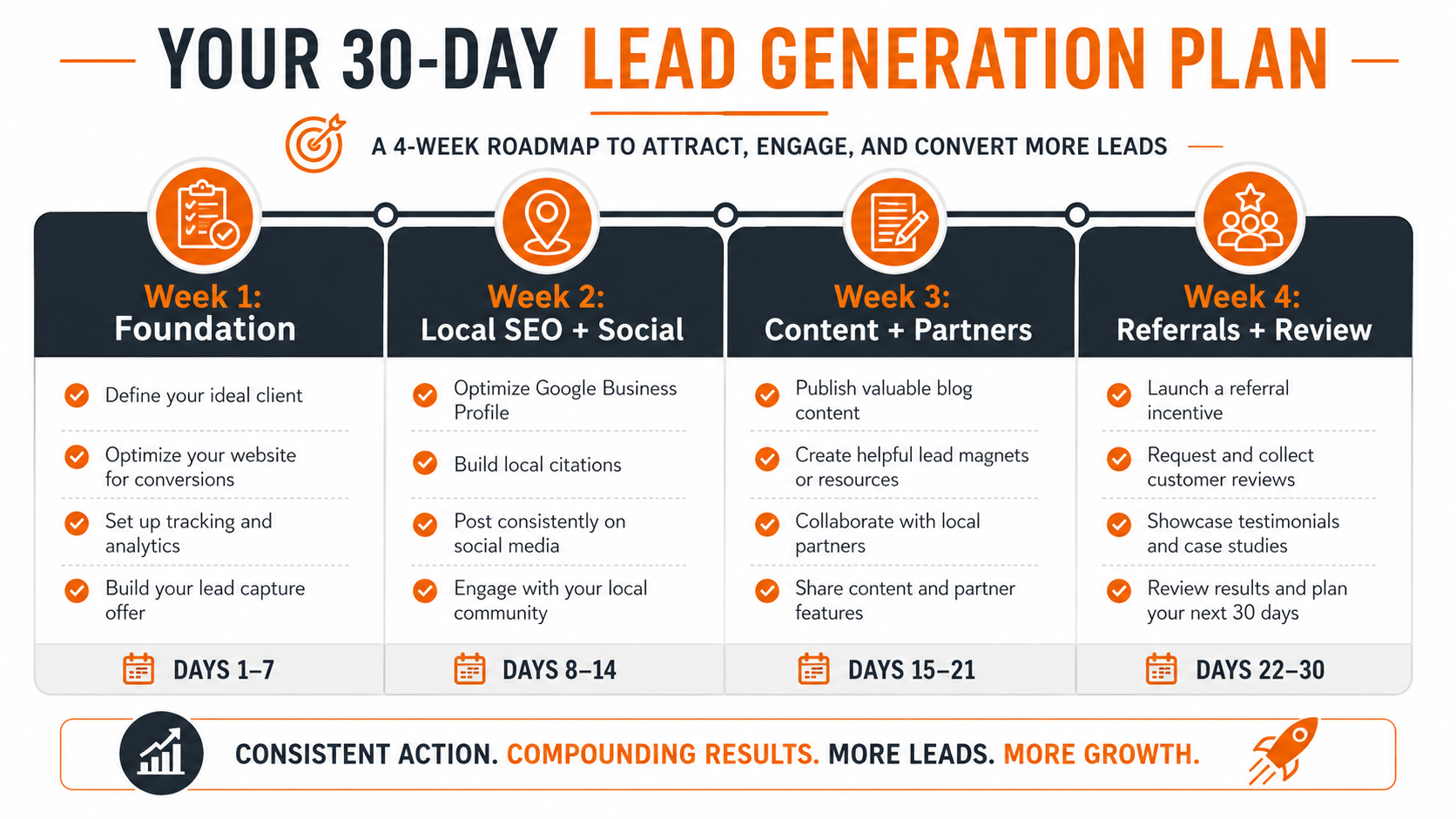
Week 1: Build your foundation – lead magnet, landing page, welcome email sequence.
Week 2: Optimize your Google Business Profile and social media bios. Start posting consistently.
Week 3: Publish your first two articles. Reach out to three potential partners.
Week 4: Launch your referral ask. Review your numbers. Double down on what worked.
For the complete system – including the exact tools, templates, and email sequences – grab the free Lead Generation Blueprint.
Frequently Asked Questions
What is the most cost-effective lead generation strategy for small businesses?
Email marketing built on a lead magnet foundation. The setup costs almost nothing, and email consistently delivers the highest ROI of any marketing channel.
How much should a small business spend on lead generation?
You can build a working lead generation system with free tools and zero ad spend. Once your free system converts well, reinvesting 5 to 10 percent of revenue into amplifying it is a reasonable benchmark.
How do I know which strategy is working?
Track one number weekly: new leads added to your email list, broken down by source. Double down on your top source and drop the weakest.
How long until I see results?
Active strategies – partnerships, communities, referrals – can produce leads within days. Content and SEO typically take two to six months but compound over time.